Pick a Door and We'll Read the Room You're In
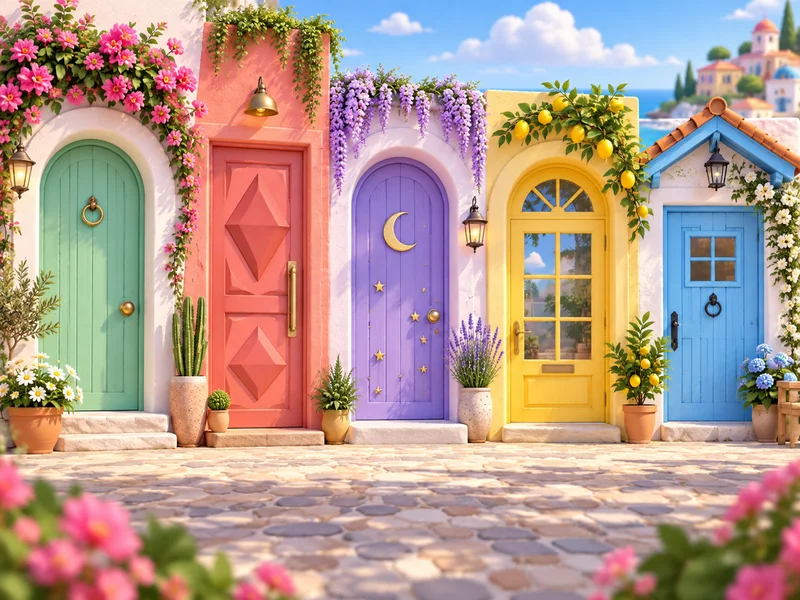
A door is a decision with a handle on it. You cannot see what is behind it, so you go on the smallest clues: the weight of the wood, the noise leaking under the gap, the way the paint has worn around the plate.
Five doors, four choices each, no wrong turns. At the end you get a room rather than a label, because rooms change with the season and labels tend to stick. Below the quiz there is a proper look at what thresholds do to a building, and to the person walking through one.
See all the outcomes this quiz can land on, and what each one means →
Why you forget what you came for
The doorway effect has one of the best names in cognitive psychology and a very ordinary demonstration. Gabriel Radvansky and colleagues had people carry virtual objects around simulated rooms, and later around real ones, then tested their memory. Recall was worse straight after passing through a doorway than after walking the same distance within a single room.
The explanation on offer is event segmentation, developed by Jeffrey Zacks and Barbara Tversky: the mind files experience in chunks, and a threshold is a natural place to close one chunk and open the next. Whatever was live in the previous room gets tidied away with it. Later work, including a 2021 study by Petra Lawrence and Oliver Baumann, found the effect is fragile and shows up most clearly when memory is already under load, a useful reminder that a charming finding is not automatically a robust one.
Christopher Alexander and the space before the door
A Pattern Language, published in 1977 by Christopher Alexander and his collaborators, treats the approach to a door as a design problem in its own right. Pattern 112, Entrance Transition, argues that a building feels like a refuge only if the arrival includes a change of light, level, surface or sound before you get inside. A path that bends, a step up, gravel giving way to tile.
The related pattern on main entrances insists the door be visible from wherever people first arrive, on the grounds that a hidden entrance makes visitors feel like intruders before anyone has said hello. Whether you buy the whole system or not, both patterns are easy to test on your own front step.
The doors of Dublin were a tourism campaign
Those rows of brightly painted Georgian doors with fanlights above them are real architecture and a genuine piece of eighteenth-century Dublin. Their fame, though, owes an enormous amount to a poster: a photographic grid of forty-odd doors, generally credited to Bob Fearon around 1970 and pushed hard by the Irish tourist board.
The stories about why they are so colourful, that widows defied an order to mourn Queen Victoria, or that residents needed to tell their house from the identical one next door after a long night, are folklore rather than record. The plain answer is that the brickwork was uniform by regulation and the door was the one place an owner could show off.
Which is the honest note to end on. A quiz cannot see the room you are standing in, and no set of doors can. It can only give you a metaphor to argue with, and the argument is where the useful thinking usually happens.
Research notes & further reading
The explanatory section above was checked against this reading trail.
More quizzes to try