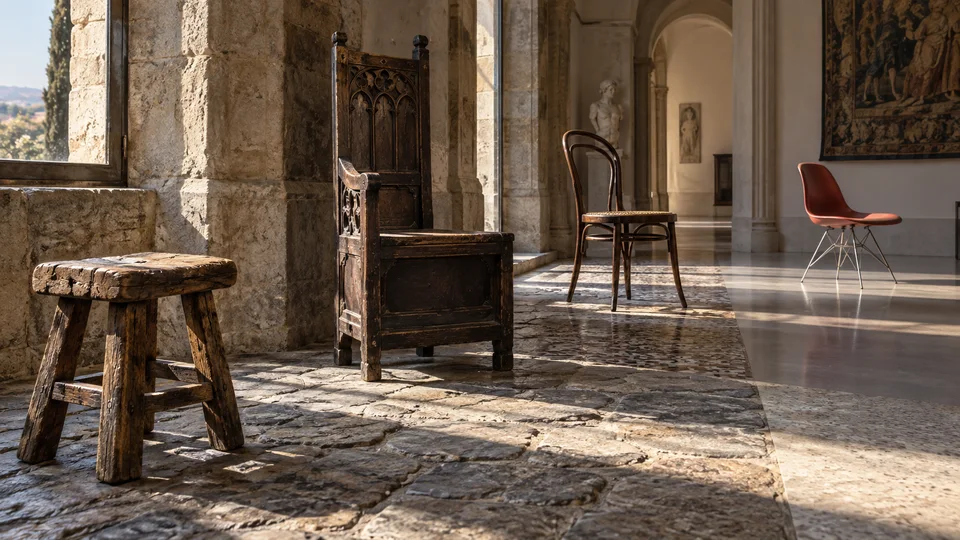
Consider the ordinary decision of where to sit. In a cafe you will scan the room and pick a table, and the choice will be quick and mostly unexamined. Back to the wall or facing the door. Near the window or tucked behind the plant. Two seats from the stranger rather than one. That small, near-automatic calculation has a long history behind it and a surprising amount of research in front of it.
Penny universities
The coffee house arrived in England in the middle of the seventeenth century, the first opening in Oxford in 1652 and one in London the same year. Within a decade there were dozens, and they became a genuinely new kind of space: somewhere you could pay a penny, sit down, read the newsletters and pamphlets on the table, and join a conversation with people you had not been introduced to. The nickname penny universities captured the deal. The price bought the drink; the value was in the talking.
What makes them worth more than a nostalgic paragraph is what grew out of them. Particular houses attracted particular crowds, and several of those crowds hardened into institutions that still exist. Lloyd's coffee house became the insurance market. Jonathan's, in Exchange Alley, is part of the origin story of the London Stock Exchange. Others were haunts of natural philosophers or poets. The furniture was the same everywhere; what differed was who kept turning up, and that alone was enough to build organisations.
They were also not the open forum the romantic version implies. Women were largely excluded as customers, and access was in practice shaped by class and trade. It is worth keeping both halves of the picture: a genuinely novel mixing space, and a limited one.
Somewhere that is neither home nor work
The sociologist Ray Oldenburg gave this category its modern name in his 1989 book The Great Good Place. His term was the third place: somewhere apart from the first place of home and the second place of work, hosting regular, voluntary and informal gatherings. Pubs, barbershops, cafes, post offices and corner shops all qualify.
Oldenburg's list of characteristics is deliberately unimpressive, which is the point. A third place is on neutral ground, so nobody is host and nobody is a guest. Status from outside is left at the door. Conversation is the main activity. It is easy to reach, has regulars who set the tone, is plain rather than grand, and the mood is playful. It feels, he wrote, like a home away from home. Project for Public Spaces keeps a summary of his argument for anyone wanting the short version.
His larger claim was civic rather than cosy: these places are where a community's informal life happens, and where people encounter neighbours they have not selected. Whether they can be deliberately manufactured, or whether they only ever accumulate, is an open question, and the number of businesses describing themselves as third places suggests the term has drifted somewhat from his intent.
The office as a long-running experiment
Workplaces are the one setting where somebody else decides where you sit, which has made them a natural laboratory. Environmental psychology has spent decades on the trade-off at the heart of office layout: openness is supposed to buy communication, but it spends privacy to do it, and workers consistently report that the loss of acoustic and visual privacy is not compensated by the gain in ease of interaction.
The most quoted recent result is blunter. Ethan Bernstein and Stephen Turban studied two corporate headquarters as they moved to open-plan layouts, using wearable sensors and email and messaging logs rather than surveys, and published the results in Philosophical Transactions of the Royal Society B in 2018. Removing the walls did not produce more face-to-face collaboration. Face-to-face interaction fell by roughly seventy per cent, while electronic messaging rose. People who could suddenly be seen by everyone appeared to withdraw, putting on headphones and typing to the person twelve feet away.
Two field studies at two companies is not the last word on offices, and the finding should be held with appropriate care. But it fits a broader pattern in this literature: layouts intended to force interaction tend to produce coping strategies instead, and the coping is usually invisible to whoever signed off the floor plan.
The interest in furniture is older than open plan. Robert Sommer, working in the 1960s, watched where people put themselves at rectangular tables in libraries and cafeterias and found the choice tracked the task. Pairs expecting to chat gravitated to a corner arrangement, at right angles across the join. Pairs working together on the same thing sat side by side. Pairs who understood themselves to be competing sat directly opposite. Anyone who simply wanted to be left alone took a seat that made every remaining chair awkward. The table is a piece of wood; the seating pattern is a social instrument.
How close is too close
Underneath all of this sits personal space. The anthropologist Edward T. Hall coined the term proxemics in the 1960s and proposed that people carry a set of nested distance zones: an intimate zone of a foot and a half or so, a personal zone out to about four feet, a social zone to roughly twelve, and a public zone beyond that. Each corresponds to a category of relationship, and the mismatch is what makes a crowded lift uncomfortable, since it puts strangers inside a distance reserved for intimates.
Hall's zones were drawn largely from observation of middle-class Americans, and treating the numbers as universal was always a stretch. Later work has taken the idea and measured it properly. A study led by Agnieszka Sorokowska, published in the Journal of Cross-Cultural Psychology in 2017, collected preferred distances from nearly nine thousand participants across forty-two countries and found substantial variation between them, along with effects of age and gender and some association with regional temperature. The structure of the zones travels better than the measurements do.
Choosing where to sit
All of which returns us to the cafe table. You are running an old and rather sophisticated calculation. You are choosing a distance from strangers that suits the relationship you have with them, which is none. You are choosing how visible you are willing to be, which is the same variable the open-plan studies keep stumbling over. And you are choosing a room whose entire commercial proposition is that you may sit in it for an hour without justifying yourself, which is the deal the penny universities invented.
It is worth noticing occasionally. The chair you take is the end of a long argument about who gets to be in public, how near they may stand, and what a room is for.