If You Turned, What Kind of Villain Would You Be?
Antagonists are not built from wickedness. They are built from a want, a grievance and a method, and the good ones are recognisable because the audience can trace the route from a reasonable feeling to an unreasonable act. Take away the cape and most of them are simply someone who stopped negotiating.
Five hypothetical questions about pressure, principle and what you would do with an unfair advantage. The result is a narrative archetype rather than a comment on your character. Underneath, a short piece on how antagonists are designed on stage and screen, and why they are drawn the way they are.
See all the outcomes this quiz can land on, and what each one means →
The heavy: a job on the nineteenth-century stage
Victorian melodrama ran on fixed roles, and companies cast to them: the juvenile lead, the ingenue, the low comedian and the heavy, which was the theatrical term for the villain. Actors specialised, sometimes for an entire career, and the audience arrived already knowing what a man in a dark cloak entering from stage left was for. That legibility was the point in venues with poor lighting, no amplification and a crowd that talked back.
The moustache-twirling image that survives today is largely a later parody of that tradition, sharpened by early cinema. What is genuinely inherited from melodrama is more interesting: the idea that the antagonist exists to apply pressure. In structural terms the villain is whoever performs the act of harm that sets the plot in motion, and everything about the character's personality is downstream of that job.
Shape language, and reading a face at a glance
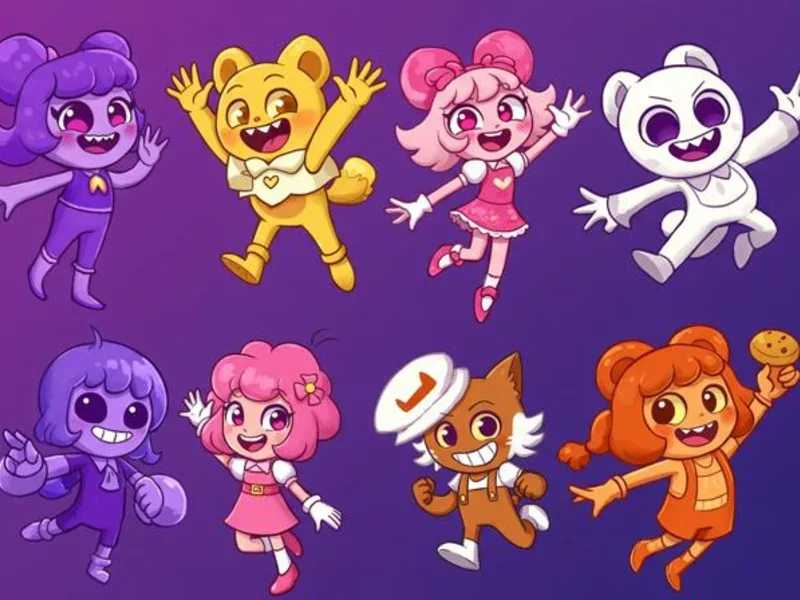
Visual development artists talk about shape language: the practice of building a design out of a dominant geometric family so an audience reads intention before they read detail. Rounded, soft forms tend to be assigned to characters meant to feel approachable, while angular, elongated and sharply pointed forms are assigned to threat. It is a convention rather than a law of nature, and it is learned by audiences through repetition, which is exactly why it works so quickly.
The same logic governs palette and staging. Antagonists are frequently given colours that appear nowhere else in the ensemble, so that a single figure entering a wide shot registers immediately, and are often lit from below or from a single hard source to break up facial symmetry. None of this is deep symbolism. It is a legibility problem being solved on a deadline, and the solutions became a visual grammar.
The origin story as a modern habit
Explaining where an antagonist came from is now close to standard practice, and it has real consequences for the shape of a story. A cause supplied for cruelty converts the villain from a force into a person, which usually deepens the drama and occasionally deflates it, since a threat that has been fully explained is a threat that has been partly disarmed.
None of which describes you
It should go without saying, but the result above is a set of narrative shapes, not a reading of your character. Five hypothetical questions cannot access anything like that, and anyone claiming otherwise is selling something. Enjoy the archetype, ignore the implication.
Research notes & further reading
The explanatory section above was checked against this reading trail.
- How Character Archetypes Actually Work — BuzzGoing background article
- Vladimir Propp, Morphology of the Folktale (University of Texas Press)
- Joseph Campbell, The Hero with a Thousand Faces (Princeton University Press)
- Alan Dundes, 'Folkloristics in the Twenty-First Century', Journal of American Folklore
More quizzes to try