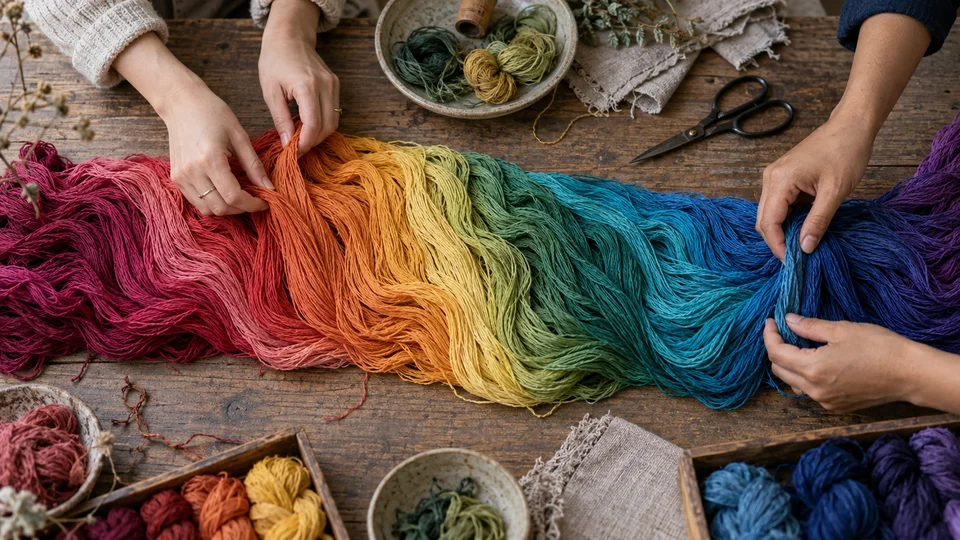
English hands you eleven colour words that need no explanation. Black, white, red, green, yellow, blue, brown, purple, pink, orange, grey. Name the colour of a passing car and one of those eleven will almost certainly do the job. Now ask a Russian speaker about a pale morning sky and you will get a word English does not carry as a single unit. The spectrum arriving at your eye is smooth and unbroken. The vocabulary laid over it is anything but.
Eleven words, in a suspiciously tidy order
The modern argument starts with Brent Berlin and Paul Kay, whose 1969 study Basic Color Terms proposed something that sounded almost too neat to be true. Languages, they claimed, do not slice the spectrum wherever they please. They pick up basic colour vocabulary in a broadly predictable sequence. A language with only two such terms tends to divide the world into something like dark and light. The third term added is nearly always red. Green and yellow arrive next, then blue, then brown, then the remainder in a looser cluster.
A basic term, in their sense, had to pass tests: one word rather than a phrase, not obviously a shade of some other term, usable for any object rather than just hair or horses, and recognised without hesitation by ordinary speakers. Crimson fails. Blonde fails. Red passes.
The claim was attacked hard and for good reasons. Early samples leaned on bilingual speakers living in industrialised societies, and the stimulus was a grid of standardised paint chips, which is not how anyone encounters colour outside a laboratory. Critics argued the ordering had been read into messy data. To settle it, Kay and colleagues ran the World Color Survey, gathering naming data from over a hundred unwritten languages spoken in small communities, with the dataset later released publicly. Kay and Terry Regier's analysis of that material, published in PNAS in 2003, found that the centres of colour categories cluster in particular regions of colour space far more than chance would predict. The strong universalist story remains contested; the weaker version, that some places in colour space are easier to name than others, has held up reasonably well.
Where the lines actually fall
Once you look past English, boundaries move about cheerfully. Plenty of languages have historically used a single term spanning what English splits into green and blue, a pattern linguists nickname grue. Japanese ao once covered both, which is why a Japanese traffic signal is still commonly described as blue when it is visibly green, and why young leaves and unripe fruit take the same word. Welsh glas has a similarly wide history.
Russian goes the other way and splits where English does not. There is no ordinary single word for the whole of blue. Lighter blues are goluboy, darker blues are siniy, and a Russian speaker cannot easily dodge the choice any more than an English speaker can call pink a shade of red in casual talk. This is not decoration. It is a compulsory division built into the vocabulary.
Two blues, and a slightly faster button press
That compulsory split gave researchers a natural experiment. Jonathan Winawer and colleagues, writing in PNAS in 2007, showed Russian and English speakers three blue squares and asked which of the lower two matched the one above. Russian speakers were faster when the two options straddled the goluboy and siniy boundary than when both sat inside the same category. English speakers showed no such kink, because for them there was no boundary to cross.
The detail that makes the result worth quoting is what happened when the task was disrupted. Giving participants a verbal load to hold in mind, a string of digits to rehearse, wiped out the Russian advantage. A spatial load did not. Whatever language was doing, it seemed to be doing it through a channel that a busy inner voice could occupy.
Even here, the story keeps moving. A 2020 paper in Cognition revisited the Russian blues effect and reported limits to how far it generalises, which is a useful reminder that a famous finding is a conversation rather than a verdict. The honest summary is that naming appears to tug at perception at the margins, in speeded tasks, under particular conditions. Nobody has demonstrated that Russian speakers see a different sky.
Colour and feeling, measured properly
The popular literature on colour and emotion is mostly assertion. There is, however, some careful work. A large study led by Domicele Jonauskaite, published in Psychological Science in 2020, asked over four and a half thousand people across thirty nations and twenty-two languages to link twenty emotion concepts to twelve colour terms.
The pattern of associations was strikingly similar worldwide. It was also not identical. A machine-learning analysis found that knowing a participant's nation predicted their associations beyond the shared pattern, and countries that were linguistically or geographically close resembled each other more. So there is something broadly shared in how people link colour to feeling, sitting underneath genuine local variation. That is a more modest claim than a chart telling you that orange means enthusiasm, and it is the one the evidence actually supports.
The red effect and its awkward decade
One strand of colour research became famous and then ran into trouble. A set of studies in the late 2000s reported that men rated women as more attractive when photographed against or wearing red, an effect explained with reference to signalling in other primates. It was a tidy story and it travelled fast.
Then people tried to reproduce it. Lehmann and Calin-Jageman ran two pre-registered replications, reported in Social Psychology in 2017, using original materials, planned sample sizes and a positive control. For men rating women they found a very small effect in the predicted direction. For women rating men they found a very small effect in the wrong direction. Neither was convincing. Similar difficulties have dogged claims that wearing red confers an advantage in sport.
This does not prove red does nothing. It does mean that anyone quoting the red effect as established is quoting a claim that has not survived careful retesting, and it belongs in the disputed column.
A nudge, not a lens
Put the pieces together and you get something less dramatic than the headlines and more interesting than the debunking. Your language does not build the eyes you see with. It does hand you a set of ready-made bins, and reaching for a bin is fast, so the bins end up faintly shaping which differences you notice quickly and which you have to stop and inspect. A Russian speaker is not living in a richer sky. They are simply carrying one extra label that fires without being asked.
Which is why arguing about whether a jumper is blue or green can go on for twenty minutes and satisfy nobody. You are not disagreeing about photons. You are disagreeing about where a word stops, and words were never designed to stop in exactly the same place for everyone.