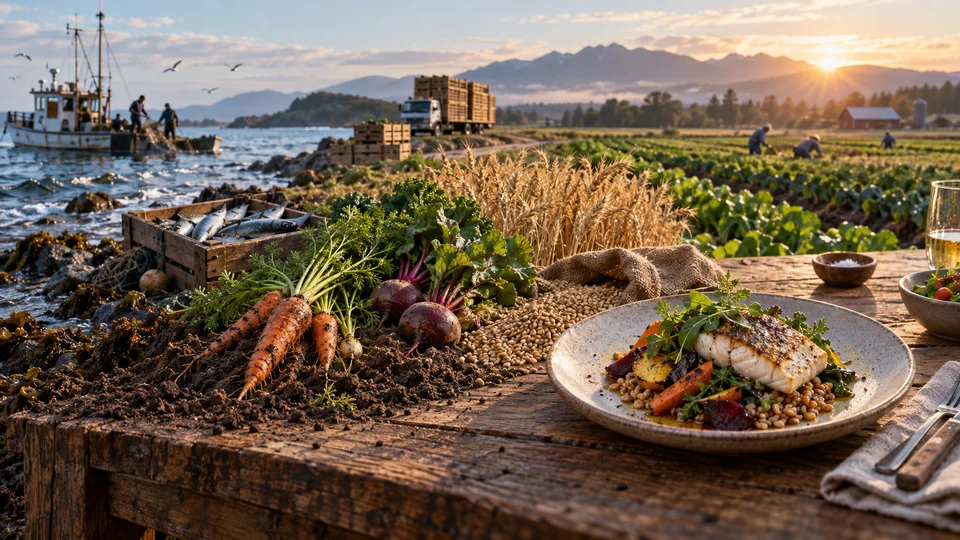
Ask where a famous dish comes from and you will usually get a confident answer within two seconds. Ask for the evidence and the confidence tends to evaporate. Food history is a field where the loudest claims are frequently the youngest, where national pride distorts the record, and where the honest verdict on a great many beloved dishes is a shrug followed by a list of candidates.
This is not a debunking exercise. Dishes are real, traditions are real, and the fact that a tradition is younger than people assume does not make it counterfeit. It does, however, make the story more interesting than the version printed on the menu.
The founding myth of spaghetti
Start with the most repeated food origin story in the world: that Marco Polo brought noodles home from China and thereby gave Italy pasta. It is a wonderful story and it was invented for a trade magazine.
The tale, as Gambero Rosso's survey of long-running food myths documents, traces to a 1929 piece in the American Macaroni Journal, the organ of the United States pasta industry, which spun a yarn about a sailor on Polo's ship who encountered a Chinese woman making noodles. The sailor was, with a straight face, named Spaghetti. Printed among advertisements for flour and pasta machinery, the story escaped into general circulation, acquired an air of authority through repetition, and turned up in a Hollywood film about Polo in 1938.
The documentary record is against it. Pasta was being made and traded in Sicily long before Polo was born. The geographer al-Idrisi, writing in 1154 for the Norman king Roger II, described a settlement near Palermo producing dried pasta in great quantity and exporting it by ship across the Mediterranean. That is not a curiosity; that is an established industry with drying techniques, packaging and export routes, which implies a good deal of history behind it already.
The exchange that rewrote every cuisine
The larger point is that most "traditional" cooking depends on ingredients that arrived recently and from very far away. The transfer of crops, animals and diseases between the Americas and the rest of the world after 1492, which historians call the Columbian exchange, reorganised what everybody ate.
Consider what came out of the Americas: tomatoes, potatoes, maize, chillies, peppers, cacao, vanilla, peanuts, pumpkins and squashes. Now subtract them. Italian cooking loses tomatoes. Irish, Polish and Russian cooking lose the potato. Sichuanese, Thai, Korean and most Indian cooking lose the chilli, which is to say they lose their defining heat, since the fiery element in all of those kitchens is a New World plant that arrived by Portuguese ship in the sixteenth century. Belgian and Swiss chocolate rests on a Mesoamerican crop. Not one of those cuisines is older, in its recognisable form, than the Atlantic crossing.
Even where the ingredient arrived early, adoption was slow. Tomatoes reached Europe in the sixteenth century and were treated for decades as ornamental oddities. The earliest known Italian recipe using them appears in Antonio Latini's Lo Scalco alla Moderna in 1692, and it is described as a sauce in the Spanish style. Pasta and tomato sauce, the pairing that now stands for an entire country, is a nineteenth-century arrangement. It is younger than the steam locomotive.
National cuisines, assembled surprisingly recently
Historians have a general framework for this. Eric Hobsbawm and Terence Ranger's idea of invented tradition describes practices that present themselves as ancient while actually being recent constructions, often built during periods of nation-building. Cuisine is a textbook case. A "national dish" requires a nation, standardised recipes, printing, railways to move ingredients and a middle class buying cookbooks. Most of that apparatus is nineteenth or twentieth century.
The Parma food historian Alberto Grandi has made a career of pressing this point about Italy, arguing in his book and in a 2023 interview with the Financial Times that carbonara is essentially a post-war invention connected to American supplies, that panettone became its familiar towering sweet form through industrial production in the twentieth century, and that Italian regional cuisine as a codified system is far younger than its mythology. The response in Italy was ferocious, with politicians and farming bodies denouncing him, and specialists disputing individual claims while conceding others. That row is worth noting honestly: Grandi's broad thesis about invented food traditions has considerable support, and several of his specific attributions remain contested. It is a live argument, not a settled verdict.
Nor is Italy unusual. Britain's chicken tikka masala is the standard example of a dish that is genuinely national and genuinely recent. In 2001 the foreign secretary Robin Cook devoted part of a speech to it, calling it a true British national dish and pointing out that it demonstrates how Britain absorbs outside influences, since the sauce was reportedly added to satisfy a British preference for gravy. Its origin remains disputed. A Glasgow restaurant has long claimed its late chef improvised the dish there in the 1970s, and in 2009 a local MP backed a bid for European protected status on that basis, while food historians have argued the dish emerged in several places at once out of much older Mughal cooking. Both things can be true: a dish can be invented repeatedly, by different people, under commercial pressure to make an unfamiliar cuisine legible to new customers.
The dishes that crossed an ocean and came back
Some of the best-documented origin stories are the ones that run in unexpected directions. General Tso's chicken is often assumed to be either authentically Hunanese or straightforwardly American. It is neither, quite. As Smithsonian Magazine records, it was created by the chef Peng Chang-kuei, who had cooked for Nationalist government banquets before leaving for Taiwan in 1949, and who developed the dish in Taipei in the 1950s in a Hunanese idiom. It reached New York later, was sweetened and deep-fried to suit American palates, and Peng was reportedly dismayed by what became of it. The general himself, a real nineteenth-century military figure, never encountered it.
Similar journeys are everywhere. Vindaloo descends from the Portuguese preparation carne de vinha d'alhos, meat in wine and garlic, reinterpreted in Goa with palm vinegar and local spice. The croissant's ancestor is the Austrian kipferl, brought to Paris in the nineteenth century by a Viennese bakery; the flaky laminated pastry we now mean by the word only appears in French recipe books in the early twentieth century, and the charming tale about it being baked to celebrate a victory over the Ottomans in 1683 has no contemporary support. Tempura is widely attributed to Portuguese traders and missionaries in sixteenth-century Nagasaki, and the connection is plausible and often repeated, though the documentary chain is thinner than the confidence with which it is asserted.
Britain's fish and chips is a merger: fried fish in batter is generally traced to Sephardic Jewish cooking brought to England, chips arrived separately, and who first sold them together is contested between a London shop of the 1860s and a Lancashire one, with neither claim decisively proved.
Why nobody can agree
The reason origin claims stay unsettled is partly that the evidence is genuinely poor. Cooking was transmitted by demonstration in kitchens, not by writing, and the people doing most of it were not the people keeping records. A dish typically exists for a long time before anyone bothers to write it down, so the first printed recipe marks the moment a dish became worth documenting, not the moment it was invented.
The other reason is that origins are now worth money and status. Protected designation schemes turn a historical claim into a trading right. Tourist boards build campaigns on being the birthplace of something. National feeling attaches to the dinner table with a force that surprises people who have never watched an argument about the correct contents of a paella.
Which is why the most accurate answer to "where does this dish come from" is usually a sentence with several clauses in it. Something moved, someone adapted it, a shortage or a surplus forced a substitution, a restaurant standardised it, and a country later decided it had always been theirs. That is not a lesser story than the legend. It is a record of people feeding each other across enormous distances, and it is on your plate tonight.